South Indian
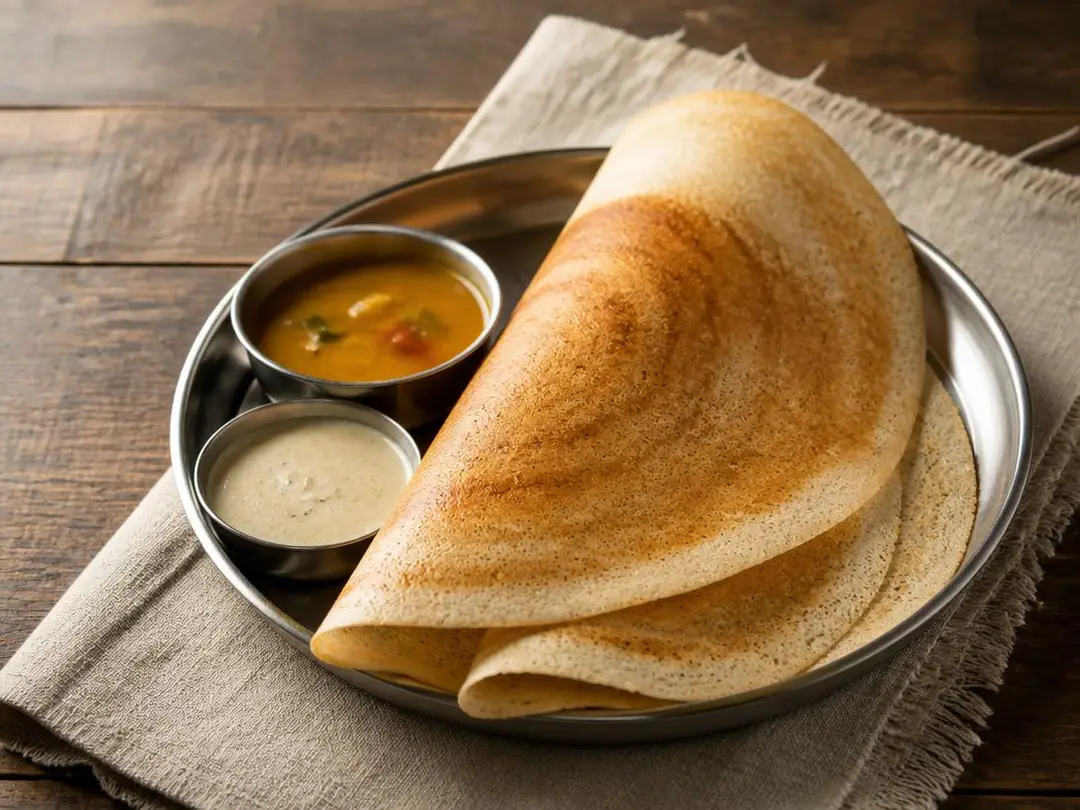
Plain Dosa
- Time
- 20 min
- Level
- Medium
- Base
- 3 servings
Cooking for
3 people
The method
Step by step
Written for first-time cooks — every quantity, timing and cue is spelled out.
- 01
Gather and Soak Ingredients
First, gather all your tools: a large mixing bowl, measuring cups and spoons, a grinder, a non-stick tawa, a ladle, a spatula, a small bowl for oil, and a kitchen towel. In the large mixing bowl, combine 1.5 cups of raw rice and 0.25 tsp of fenugreek seeds. In a separate small bowl, place 0.5 cup of urad dal. Rinse both the rice mixture and the dal under running water 2-3 times until the water runs clear. Then, add enough fresh water to each bowl to cover the grains by about 2 inches. Let them soak at room temperature for at least 6 hours, or up to 8 hours. The grains will swell up.
- 02
Grind the Dal
After soaking, drain the water from the urad dal. Transfer the soaked dal to your grinder. Add about 0.25 cup of fresh water to the grinder. Grind the dal until it forms a very smooth, fluffy paste. This should take about 10-15 minutes in a wet grinder, or 5-7 minutes in a powerful blender, adding a tiny splash of water (1-2 tsp) only if needed to keep the blades moving. The batter should be light and airy. Transfer this ground dal batter to the large mixing bowl.
- 03
Grind the Rice
Drain the water from the soaked rice and fenugreek seeds. Add the rice mixture to the grinder. Add about 0.5 cup of fresh water. Grind the rice until it forms a smooth but slightly grainy batter. It should not be as smooth as the dal, but there shouldn't be any whole rice grains visible. This usually takes 10-15 minutes in a wet grinder, or 5-7 minutes in a powerful blender, again adding tiny splashes of water (1-2 tsp) if necessary. Add this ground rice batter to the same large mixing bowl with the dal batter.
- 04
Mix and Ferment the Batter
Add 0.75 tsp of salt to the batter in the large mixing bowl. Using your clean hands (this helps with fermentation), mix the dal and rice batters thoroughly for about 2-3 minutes. The mixture should be well combined and have a consistent texture. Cover the bowl with a lid, leaving a small gap for air to escape, or use a plate that doesn't seal completely. Place the bowl in a warm spot in your kitchen (like inside a microwave or oven that is turned off) and let it ferment overnight, or for 8-12 hours.
- 05
Check for Fermentation
The next morning, check the batter. It should have doubled in volume, look bubbly and airy, and have a slightly sour smell. If it hasn't risen much, give it a few more hours in a warm spot. Once fermented, give the batter a gentle stir with a ladle. If it's too thick (it should be pourable, like pancake batter), add 1-2 tbsp of water at a time until it reaches the right consistency.
- 06
Prepare the Tawa
Place your non-stick tawa on a stove burner and turn the flame to medium-high. Let the tawa heat up for about 3-4 minutes. To check if it's hot enough, sprinkle a few drops of water on it; they should sizzle and evaporate quickly. If the tawa is smoking, it's too hot, so reduce the flame slightly. Dip a piece of kitchen towel in a small bowl with 1 tsp of cooking oil and lightly grease the tawa. This helps the dosa not stick.
- 07
Pour and Spread the Dosa
Reduce the flame to medium. Take a ladleful of dosa batter (about 0.5 cup). Pour the batter directly in the center of the hot tawa. Immediately, using the bottom of the ladle, start spreading the batter in a circular motion, moving outwards from the center to form a thin, even circle, about 7-8 inches in diameter. Work quickly and gently to make it as thin as possible.
- 08
Cook the Dosa
Increase the flame back to medium-high. Drizzle 0.5 tsp of cooking oil around the edges and a few drops on top of the dosa. Let it cook for 2-3 minutes. You will see the edges start to lift and turn golden brown, and the top surface will look cooked and dry. Use a spatula to gently lift the dosa from the edges and check if the bottom is golden and crisp. If it is, you can fold it in half or roll it up. You do not usually cook plain dosa on both sides.
- 09
Serve and Repeat
Carefully transfer the cooked dosa to a plate. Wipe the tawa lightly with the oiled kitchen towel again before making the next dosa. This cools the tawa slightly and ensures the next dosa spreads easily. Repeat the pouring, spreading, and cooking steps for the remaining batter. This recipe makes about 6-8 dosas, which is enough for 3 servings (2-3 dosas per person).